Web site: www.threedee.com/jcm/psystem/
Origin: USA
Category: workstation
Desktop environment: CLI
Architecture: DEC PDP-11
Based on: Independent
Wikipedia: UCSD_Pascal
Media: Install
The last version | Released: 1980 (?)
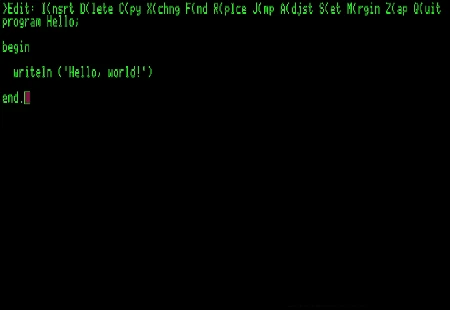
UCSD P-System – a portable operating system that was popular in the early days of personal computers, in the late 1970s and early 1980s.
Like today’s Java, it was based on a “virtual machine” with a standard set of low-level, machine-language-like “p-code” instructions that were emulated on different hardware, including the 6502, the 8080, the Z-80, and the PDP-11. In this way, a Pascal compiler that emitted p-code executables could produce a program that could be run under the P-System on an Apple II, a Xerox 820, or a DEC PDP-11.
The most popular language for the P-System was UCSD Pascal. In fact, the P-System operating system itself was written in UCSD Pascal, making the entire operating system relatively easy to port between platforms.
By writing a p-code interpreter in the platform’s native assembly language, and a few minimal hooks to operating system functions for the file system and interacting with the user, you could move a p-code executable from another system and run it on the new platform. In this way, the p-code generated on one computer could be used to bootstrap the port of the P-System to another computer.